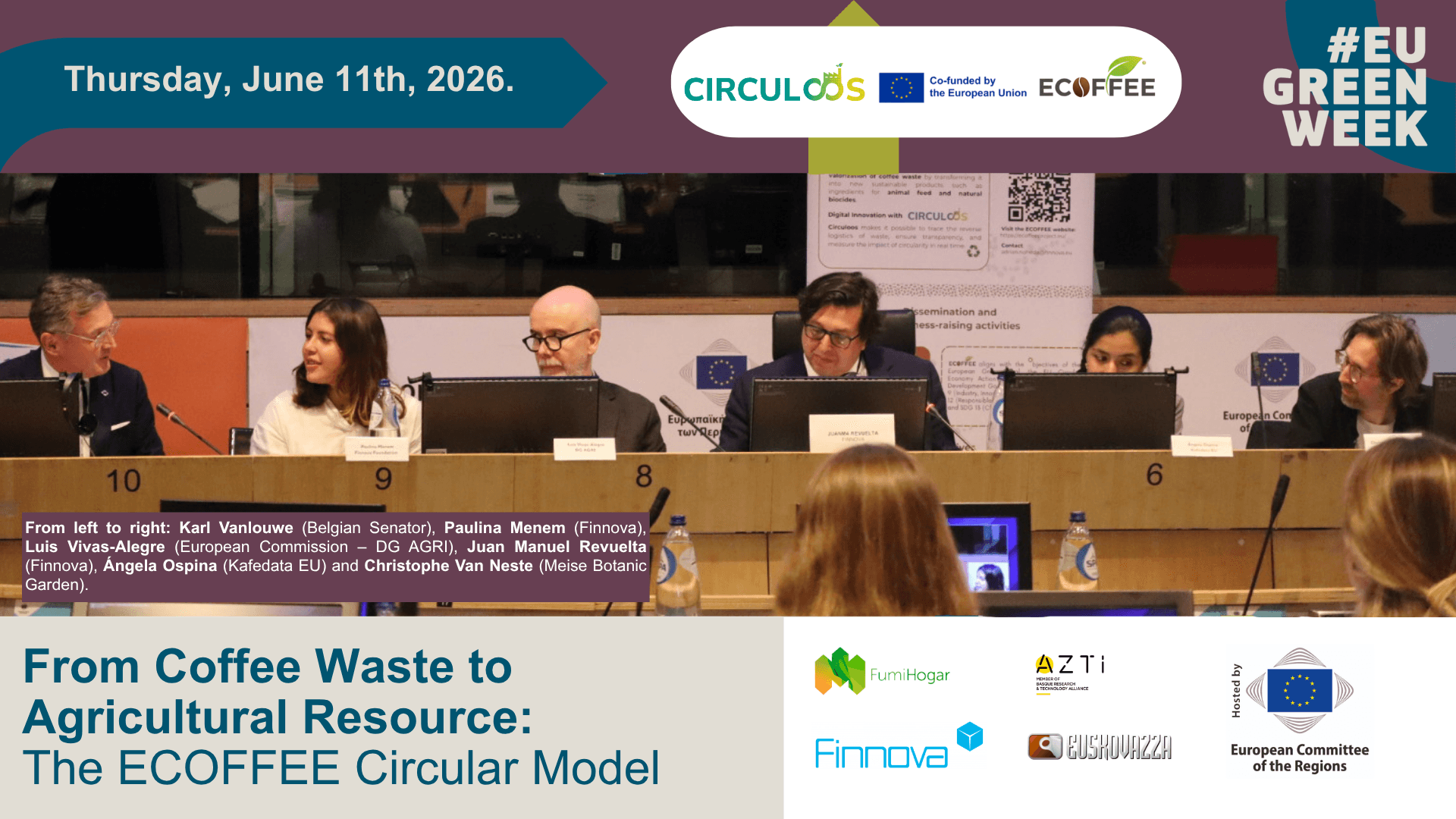
During the event in Brussels the project demonstrated its circular and digital model to recover spent coffee from the HORECA sector, achieving a 30 percent reduction in CO2 emissions
BRUSSELS, 12 June 2026. In the framework of the EU Green Week, the Finnova Foundation has successfully organized the hybrid event From coffee waste to agricultural resource and the ECOFFEE circular model, held today at the European Committee of the Regions in Brussels. The high level session was inaugurated by Karl Vanlouwe, Member of the Flemish Parliament, Senator of Belgium and Member of the European Committee of the Regions, who highlighted in his opening speech the importance of regional leadership for the green transition.
Following the institutional opening, Luis Vivas-Alegre, Head of Sector for Research & Innovation Coordination at the European Commission’s Directorate-General for Agriculture and Rural Development (DG AGRI), highlighted the role of innovation in shaping the future of the agri-food sector and rural areas. During his intervention, he stated that “for the future of agriculture and rural areas, innovation is a key pillar” and noted that the European Commission has already put forward, as one of the first initiatives of its new mandate, the Vision for Agriculture and Food, a strategic document presenting ideas and proposals to address the main needs and challenges facing agriculture in the European Union and globally.
The meeting served as an international showcase to present the technical progress of the ECOFFEE project, a European initiative aimed at giving a second life to spent coffee grounds and capsules generated in the hospitality and vending sector. Through a collaborative value chain, this circular economy and reverse logistics model manages to recover these wastes to transform them into highly valuable ingredients for animal nutrition and into natural biocidal and phytosanitary products.
During the day, the consortium partners detailed the pillars of this process that reduces CO2 emissions by 30 percent thanks to digitalization. Mónica Gutiérrez, from the Efficient and Sustainable Processes area of the AZTI research centre, explained the nutritional characterization of coffee for the development of animal feed and the validation of the environmental impact through the Life Cycle Assessment using the GRETA digital tool. For his part, Iker Beristain, representing Euskovazza SL, detailed the reverse logistics and smart secondary product collection model, whose data feeds the RAMP commercial traceability digital platform. In addition, Carlos Ramos from FumiHogar presented the innovation of FUMICOFFE natural biocides to replace chemical pesticides, highlighting the technical synergies with the parallel LIFE NextFUMIGREEN project.
Transatlantic synergies and the future of the bioeconomy
The event transcended European borders to become a forum for international cooperation. In a roundtable focused on the replicability of the model in the primary sector, experts such as Paulina Menem from the AL INVEST Verde Programme of the Finnova Foundation and Ernesto Ussher from Phynatura, debating by the opportunities for agricultural innovation and regenerative agriculture between the European Union and Latin America. The day also featured the valuable perspectives of Angela Ospina from Kafedata EU, Mariamawit Solomon from the Center for Circular Economy in Coffee and Christophe Van Neste from Critical Coffee.
Citizen awareness and policy recommendations
The closing of the event was carried out by Juan Manuel Revuelta, CEO of the Finnova Foundation. In his speech, in addition to reviewing European funding opportunities for innovation, Revuelta highlighted the dissemination and citizen awareness actions that the foundation leads within the project. These campaigns seek to encourage a change in behavior towards the sustainable consumption of coffee in the hospitality and vending sector.
To achieve this impact, the project deploys regional awareness actions in Spain, focused on the Basque Country, Andalusia and the Valencian Community, complemented by training workshops for sector professionals. Revuelta also underlined the political advocacy work of ECOFFEE in Brussels, whose objective is to elevate the results of the project and present regulatory recommendations to European institutions, including key directorates such as DG ENV and DG GROW of the European Commission.
Watch the full event recording here: https://ecoffeeproject.eu/eventos?lang=en
About the ECOFFEE project
The ECOFFEE project consortium is led by the AZTI technological centre as coordinator, alongside the vending company EUSKOVAZZA, the biocide manufacturer FumiHogar and the Finnova Foundation, in charge of the European policy, communication and dissemination strategy.
This full scale project has been jointly funded by the European Union through the Horizon Europe programme under Grant Agreement number 101092295. It has a total budget of 256,451.25 euros, with a European grant of 195,370.75 euros, and a duration of 12 months. To learn about the upcoming steps and technical results of the project, visit the official website at ecoffeeproject.eu.