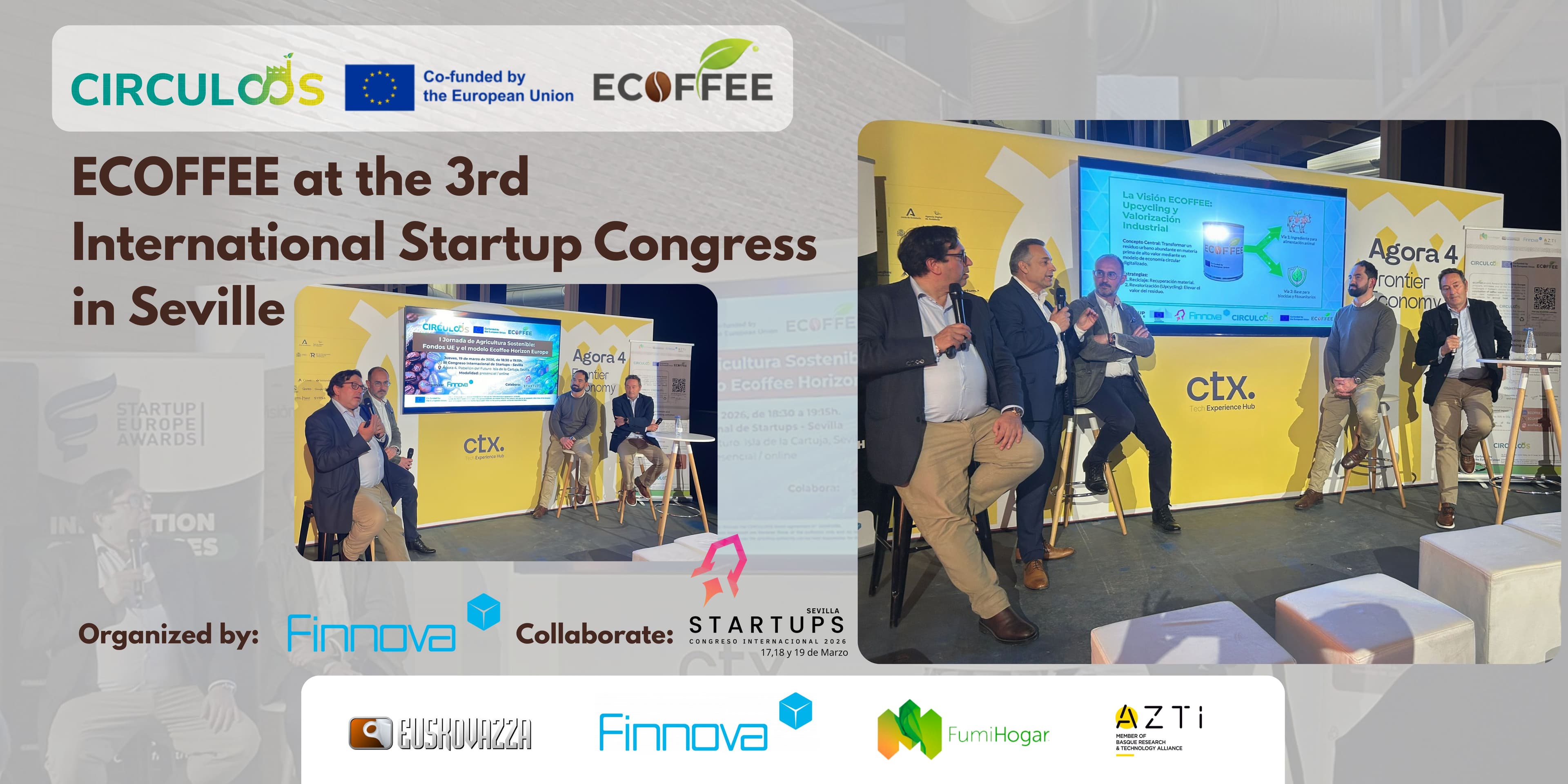
The session, held in Agora 4 of the Seville Tech Park, brought together international experts to analyze how innovation and European funding can drive a more sustainable and circular agriculture.
Brussels, March 23, 2026. The Finnova Foundation held the 1st Sustainable Agriculture Conference: EU Funds and the ECOFFEE Horizon Europe Model last Thursday, March 19. The event focused on the opportunities offered by European funding to transform the agri-food sector towards more sustainable, circular, and resilient models. The activity took place within the framework of the 3rd International Startup Congress at the Seville Tech Park – Pavilion of the Future, and included both in-person and online participation.
The roundtable discussion was held in Agora 4, starting at 6:30 p.m., and was broadcast live to facilitate access for professionals throughout Europe and Latin America.
A panel of experts to address the challenges and opportunities of the agri-food sector
The panel, coordinated by Finnova, brought together leading specialists in the circular economy, innovation, and sustainable agriculture:
Juanma Revuelta, CEO of Finnova, opened the session by highlighting the role of European funding as an engine for scaling innovative solutions in the agri-food sector. With more than two decades of experience in European programs, Revuelta emphasized the importance of connecting startups, public administrations, and research centers to accelerate the transition to more sustainable models. He also presented Finnova's strategy to promote bioeconomy and circular economy projects within the framework of Horizon Europe.
Milton Restrepo, Director of the Glocal Circular Economy Summit and former Secretary of Government of Ibagué (Colombia), provided an international perspective on waste management, territorial governance, and the need to integrate public policies with business innovation.
José F. Calero and Roberto Vélez, representatives of Sicloo Circular Ventures, presented their circular economy model applied to the HORECA sector and Andalusian agriculture.
Francisco Antonio Corpas Iglesias, Professor at the University of Jaén, provided the academic and scientific perspective for the meeting. A specialist in plant physiology and biotechnology, Corpas explained the benefits of organic and regenerative fertilizers for soil health, agricultural productivity, and the reduction of imported chemical inputs. His presentation connected university research with the real needs of the agricultural sector.
During the session, Juanma Revuelta analyzed how European Funds—including Horizon Europe, LIFE, Interreg, and Next Generation EU—can accelerate the adoption of innovative solutions in agriculture, from soil regeneration to the valorization of organic waste, as well as digitalization and traceability.
“Today’s waste is tomorrow’s resource. Projects like ECOFFEE demonstrate that, with the support of funds like Horizon Europe, we can radically transform the agricultural sector towards a circular, profitable, and environmentally friendly model,” highlighted the CEO of Finnova.
Circular Economy Applied to Coffee: The ECOFFEE Case Study
One of the central themes of the day was the presentation by Juanma Revuelta of the ECOFFEE project model, funded by the European Union through the CIRCULOOS program (Grant Agreement No. 101092295). ECOFFEE develops solutions to transform coffee waste into high-value-added bioproducts, contributing to a more sustainable agri-food chain aligned with the objectives of the European Green Deal.
As highlighted by GlobalStartups magazine in its special edition on the International Startup Congress, ECOFFEE has established itself as a European success story in circular economy applied to the primary sector, with a replicable approach and a measurable impact on sustainability, innovation, and competitiveness.
Sicloo Circular Ventures: Closing the Cycle Between City and Countryside
The event also provided an opportunity to learn about Sicloo Circular Ventures, an initiative born in Seville that works to close the cycle between city and countryside by transforming coffee grounds and other organic waste from the HORECA sector into regenerative fertilizers.
Sicloo establishes a circular ecosystem based on:
· Low-emission reverse logistics for waste collection.
· Digitalization and traceability, with verifiable metrics and its own certification.
· Applied biotechnology, generating fertilizers and future byproducts such as pellets, biochar, and polyphenols.
· Direct application to local crops, contributing to soil regeneration and reducing imported chemical inputs.
The project boasts a multidisciplinary team, including José F. Calero (CEO) and Roberto Vélez (Partner), experts in supply chain, circular economy, and the development of sustainable business models, with international experience in innovation projects.
A meeting to connect innovation, entrepreneurship, and European funding
The 1st Sustainable Agriculture Conference was held within the framework of the CTX – International Startup Congress, which took place from March 17 to 19 in Seville. This forum brought together more than 1,500 entrepreneurs, investors, corporations, and public administrations, establishing itself as a key space for promoting innovative projects and facilitating access to European funding.
Finnova actively participated with the aim of bringing the opportunities of European programs closer to startups and SMEs, especially in strategic sectors such as agriculture, the bioeconomy, and the circular economy.
About ECOFFEE
ECOFFEE has a budget of €256,451.25, co-financed by the European Union through the Horizon Europe program (Grant Agreement CIRCULOOS No. 101092295). The consortium is made up of AZTI, Euskovazza, FumiHogar, and the Finnova Foundation, and its objective is to demonstrate a comprehensive model for the valorization of coffee grounds using innovative technologies and digital traceability.
More information: https://ecoffeeproject.eu/