
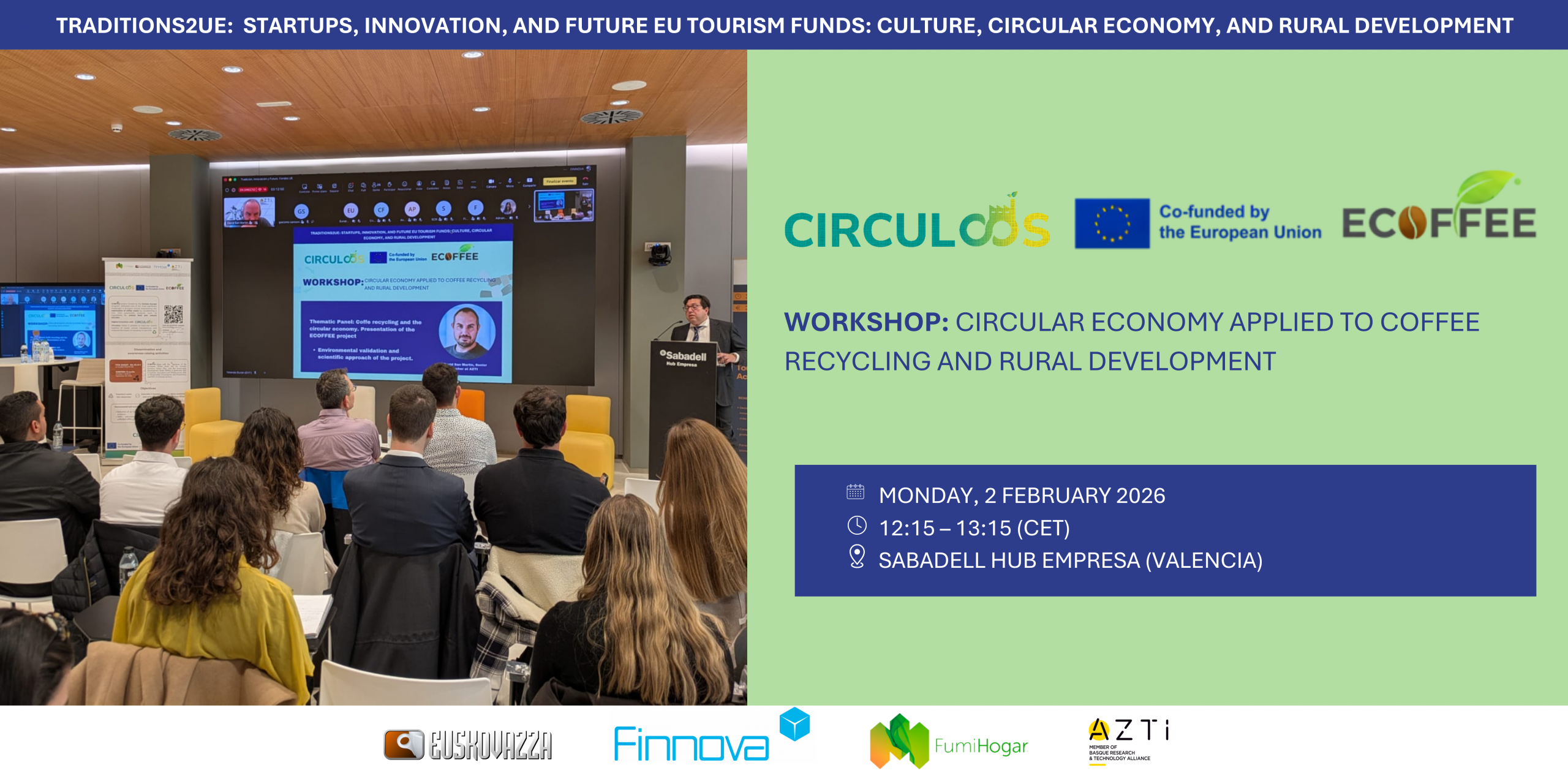
The workshop, held this Monday, 2 February, at Sabadell HUB Empresa, brought together experts from Spain, Brussels, and Latin America to discuss circular economy and the revalorization of by-products from the coffee sector.
Valencia, 4 February 2026. The European project ECOFFEE, funded by the Horizon Europe programme through the CIRCULOOS ecosystem, led the workshop “Coffee recycling and the circular economy” in Valencia. The event took place on Monday, 2 February, at Sabadell HUB Empresa (Valencia), with both onsite and online participation. The workshop was part of the European TRADITIONS2EU event promoted by the Finnova Foundation and held in the Valencian Community.
Success stories in the circular economy of coffee
Through the exchange among stakeholders, the ECOFFEE workshop provided a space for public administrations, companies, entrepreneurs, and European project managers to share and learn about the latest innovations in the coffee sector and the circular economy.
The workshop began with an introduction and presentation of the event’s objectives by Juan Manuel Revuelta, CEO of Finnova. During his intervention, he highlighted the importance of innovation and public–private collaboration to drive projects aligned with circular economy and sustainability.
Next, the thematic panel “Coffee recycling and the circular economy” took place, featuring a presentation of the ECOFFEE project and its capacity to promote environmental initiatives and emphasize their scientific value. The panel included David San Martín, Senior Researcher at AZTI, who focused on each phase of the process to reuse coffee and turn it into nutritional feed. “Our goal is to demonstrate and implement, at real scale, an innovative and sustainable solution for recovering coffee by-products and valorizing them as ingredients for animal feed and for the production of biocides,” San Martín stressed.
This business model was complemented by the presentation of Carlos Ramos, Operations Manager at FUMIHOGAR, who introduced FumiCoffe, a product for fumigating spaces—such as shops or companies—derived from coffee grounds.
In addition, Iker Beristain, Manager of EUSKOVAZZA, addressed the potential of recycling coffee waste as a key resource within circular economy models. “Our multichannel approach allows us to reach the different professional sectors where coffee waste is generated,” Beristain explained, referring to the reverse logistics for collecting coffee capsules and grounds.
Afterwards, Paulina Menem, EU Project Manager, highlighted the success of projects already completed or underway in the coffee sector that stand out for their innovation and environmental contribution. Examples include Café Sostenible AL-INVEST VERDE and the Project T.I.E.R.R.A. Coffee.
To close the workshop, Milton Restrepo, Director of Ibagué Limpia, focused on the potential of startups as key actors for innovation in sustainability, also applicable to coffee recycling. As proof of this, Restrepo emphasized the opportunity presented by the Ibagué Startup Europe Awards, which connect new tech companies, investors, universities, and media to foster business development. Applications for the awards close on 27 February.
If you want to watch the day again, click here.
About the ECOFFEE project
This event is part of ECOFFEE’s regional action under task 3.4 in Spain, within its dissemination and awareness activities, aimed at increasing the project’s visibility, transferring knowledge, and raising awareness among public and private stakeholders about the potential of coffee waste in circular economy models. The event, held both onsite and online, was coordinated by the Finnova Foundation with the support of project partners AZTI, EUSKOVAZZA, and Fumi Hogar.
ECOFFEE is an innovation project funded by Horizon Europe, supported by CIRCULOOS, with a duration of 12 months and a total budget of €256,451.25. The project aims to transform coffee grounds into high-value biobased products through the application of circular economy principles, reverse logistics, digital traceability, and environmental validation.
Deja una respuesta